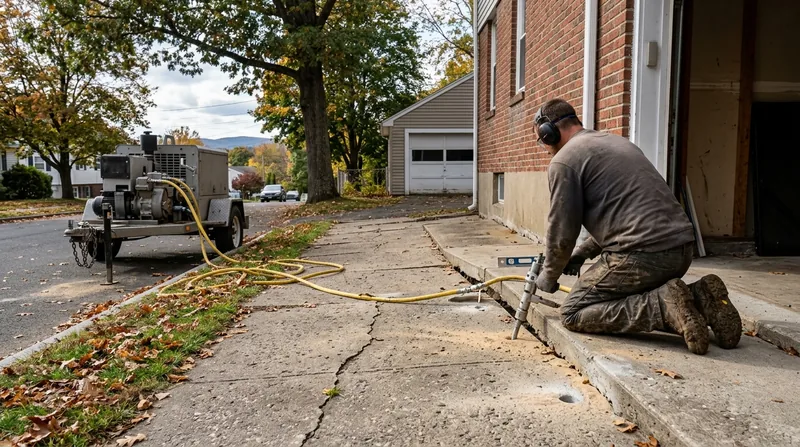




Concrete Leveling & Slab Lifting in Springfield solves one of the most stubborn problems homeowners face in the Connecticut River valley: sunken driveways, patios, and walkways caused by soil settling and freeze-thaw cycles. Springfield sits on old glacial lake silts and varved clays mixed with sandy outwash, a combination that heaves and shifts dramatically during the dozens of freeze-thaw cycles our winters bring. When that happens, your front walk develops a dangerous lip, your driveway settles into a bowl, or your patio tips toward the foundation. Rather than tear out and replace the whole slab, we lift and level it back into place using proven mudjacking and polyurethane injection methods. It's faster, cleaner, and far more affordable than demolition and new concrete.
Why Concrete Settling Happens in Springfield: Freeze-Thaw Damage and Soil Movement
The Connecticut River valley's landscape tells the story. Beneath the three-decker blocks of Indian Orchard, the Victorian Queen Annes of McKnight, and the Cape Cods and ranches of Sixteen Acres lies glacial till that expands and contracts with every winter thaw. The frost line in Massachusetts runs 48 inches deep, and we routinely see temperatures swing from below zero to above freezing multiple times each season. Water infiltrates the soil beneath your concrete, freezes, expands, and lifts the slab unevenly. Then spring thaw creates voids. Over a few years, narrow side driveways and front walks with poured steps settle 2, 3, or even 4 inches, creating trip hazards and water pooling that accelerates the damage.
- Freeze-thaw cycles cause soil beneath concrete to heave and then settle unevenly, leaving one edge higher than the other.
- Poor drainage around foundation slabs and garage floors allows water to pool, weakening subgrade support over time.
- Tree roots and organic matter in the glacial silts decompose, creating subsurface voids that collapse under slab weight.
- Road salt applied to driveways penetrates cracks and accelerates spalling, which can mask the settling problem until it becomes a safety issue.
- Narrow side driveways in Springfield's historic neighborhoods have minimal slope, so even small settlement creates pooling and accelerated deterioration.
Left unaddressed, a settled slab eventually cracks, water infiltrates further, and you face either a dangerous trip hazard or the full expense of removal and replacement.
Key info: Springfield homeowners often wait too long to address settled concrete because the problem develops slowly. A sunken driveway in Forest Park or a tilted patio in Longmeadow looks bad, but it feels like a cosmetic fix until someone trips or water backs up into the basement. Leveling catches the problem before that happens and costs a fraction of replacement.
For more on how settlement affects your entire foundation and slab system, see our guide to Concrete Slabs & Foundations in Springfield.
You can also check Massachusetts homeowner foundation and basement guidance from the state, which addresses settling and drainage as common structural concerns.
How Concrete Leveling Works: Our Process from Assessment to Finished Slab
We start every leveling job with a thorough inspection of the sunken slab, checking for cracks, water damage, and the depth and direction of settlement. We measure the high and low points, assess soil conditions and drainage, and determine whether mudjacking or polyurethane foam injection is the best fit for your situation. Once we've identified the approach, we drill small ports into the slab, inject material beneath it to fill voids and restore support, and monitor the lift in real time. The whole process usually takes a single day, and you can use the driveway or patio within hours.
- We conduct a site visit to measure settlement, identify cracks, and test soil bearing capacity beneath the slab.
- We drill strategically placed 1.5-inch injection ports into the concrete at points of maximum settlement.
- We pump either limestone slurry (mudjacking) or expanding polyurethane foam beneath the slab to fill voids and lift it back to grade.
- We monitor the slab with laser levels during injection to ensure even, controlled lift and prevent overjacking.
- We seal injection ports with concrete and clean the site, leaving the driveway or patio ready to use immediately.
The result is a level, safe surface that performs like new without the cost, mess, or downtime of full replacement.
Real example: A homeowner in Wilbraham had a front walk that had settled 3 inches on one side, creating a dangerous trip hazard and pooling water against the foundation. We injected polyurethane foam beneath the settled section, lifted it back to level with the higher portion, and sealed the injection points. Total time on site: 3 hours. Total cost: less than half what a full replacement would have been. The walk has remained stable for over two years.
For related concrete repair work, see our full range of Concrete Repair & Resurfacing services.
Mudjacking vs. Polyurethane Foam: Methods and When to Use Each
| Approach | Description | Best for |
|---|---|---|
| Mudjacking (Slab Jacking) | Injection of a limestone slurry and cement mixture beneath the slab to fill voids and lift the concrete back to grade. Proven method used for decades on driveways, patios, and garage floors across New England. | Large slabs with broad settlement, basement floors, and situations where long-term stability and soil compaction are priorities. Cost-effective for driveways and patios in Springfield. |
| Polyurethane Foam Injection | Injection of expanding polyurethane foam that hardens in place, filling voids and lifting the slab with minimal pressure. Lighter material, faster cure time, and more precise control of lift. | Smaller slabs, walkways, and areas where soil conditions are soft or where minimal drilling footprint is required. Ideal for front walks and narrow side driveways in dense neighborhoods. |
| Slab Replacement | Full removal of the settled concrete and pouring of a new slab with proper grading, drainage, and compacted subgrade. More invasive and time-consuming, but creates a completely new surface. | Severely cracked slabs, areas with recurring settlement due to poor drainage, or when aesthetic upgrades (stamped or colored concrete) are desired alongside structural repair. |
| Polyurethane Injection with Sealing | Polyurethane foam injection paired with concrete sealing to protect the lifted slab from future water infiltration and freeze-thaw damage. Combines structural fix with weatherproofing. | Homeowners seeking long-term protection after leveling, especially in Springfield's harsh freeze-thaw climate where sealed concrete lasts 50% longer than unsealed. |
Concrete Leveling & Slab Lifting Cost in Springfield: What to Expect
Concrete leveling costs in Springfield typically start at $4 per square foot for mudjacking and rise to $6 to $8 per square foot for polyurethane foam injection, depending on the size of the slab, the depth of settlement, soil conditions, and access. A typical 400-square-foot driveway or large patio might run $1,600 to $3,200 for leveling, compared to $4,000 to $6,000 or more for full replacement with new concrete. Smaller jobs like a front walk (100 to 150 square feet) can be done for $400 to $1,200. The exact price depends on how much material we need to inject, how many ports we drill, and whether soil conditions require additional preparation or stabilization.
Several factors move the cost within that range. A driveway with 4 inches of settlement requires more material than one with 1 inch. Soft, organic-rich soils (common in Springfield's glacial silts) may need extra passes or larger injection volumes. Slabs near trees or with poor drainage require more work. Access matters too: a narrow side driveway in Forest Park or a back patio in Longmeadow may require hand-drilling rather than a truck-mounted rig, which adds labor. We always recommend getting 2 to 3 estimates from insured contractors so you can compare methods and pricing.
For a detailed breakdown and a free, no-obligation estimate, visit our Pricing page or contact us today at (413) 288-4351.
Concrete Leveling & Slab Lifting Near Me: What to Look for When Hiring a Contractor in Springfield
Choosing the right contractor for concrete leveling is as important as choosing the method. You want someone who understands Springfield's soil and climate, has done this work on similar homes in your neighborhood, and can explain the process clearly. Start by asking potential contractors for references from recent jobs in your area, particularly homes in similar vintage and terrain (three-deckers in Indian Orchard, Colonials in Longmeadow, ranches in Sixteen Acres, etc.). Check that they carry general liability insurance and workers' compensation coverage on every job, and request a certificate of insurance before work begins. Get at least two detailed estimates that break down the method, material, square footage, and timeline, so you can compare apples to apples.
Ask about permits. Some municipalities in Springfield's service area require permits for driveway or sidewalk work, especially if the slab is in a right-of-way or affects curb cuts. A reputable contractor will know local requirements and handle that paperwork. If you live in an HOA community (common in Longmeadow and Wilbraham), verify whether HOA approval is needed before work starts. Finally, understand the warranty: most leveling jobs carry a 1 to 2-year guarantee against settling or cracking, but confirm what's covered and for how long.
Ready to get started? Contact Springfield Concrete for a free estimate and expert guidance tailored to your specific slab and situation.
Concrete Leveling & Slab Lifting in Springfield: Pricing Guide
| Service | Price | Details |
|---|---|---|
| Mudjacking, standard depth settlement | Starting at $4/sq ft | Limestone slurry injection for driveways and patios with 1 to 2 inches of settlement and stable soil conditions |
| Polyurethane foam injection, walkways and narrow slabs | Starting at $6/sq ft | Expanding foam for small front walks, side driveways, and areas requiring minimal drilling and faster cure time |
| Deep settlement or poor soil conditions | $7 to $8/sq ft | Soft glacial silts or organic-rich subgrade requiring additional material and multiple injection passes for stable lift |
| Leveling plus concrete sealing | Starting at $8/sq ft | Combined slab lifting and protective seal coat to prevent future freeze-thaw damage and water infiltration |
| Estimate and site inspection | Free | On-site assessment with laser measurement and method recommendation, no obligation to book, response within 24 hours |
Indicative pricing, the exact cost depends on square footage, finish, and site access. Free personalized estimate within 24h at (413) 288-4351.


